
Hartford County Wanted List
Hartford has no verified, ongoing most wanted list. Its police department does not maintain one. Connecticut dismantled its county sheriff and jail system long ago, so no Hartford County sheriff picks fugitives, posts photos, or runs a warrant unit. HPD may put out a dated notice about one person. Other agencies publish their own. Each item stands alone, with its own date and scope. Stitching them into a permanent Hartford wanted list would fake a completeness that just isn't there.
With no maintained list, there is also no honest count, posting schedule, photo policy, reward program, or standard listing fields to report. Those details aren't zero. They're simply not published or verified. To check a warrant on a named person, start with the Connecticut Judicial Branch Arrest Warrants and Violation of Probation search. Even that tool warns some warrant types may be missing. A blank result can't clear anyone completely.
Hartford Wanted Listing Fields
A field inventory only helps if a real list sits behind it. Hartford has no verified maintained HPD roster. So the table below separates publication details that are absent from facts that were checked and found missing. A single police release may include a name, image, alleged conduct, or caution language. Its fields describe that notice alone. The Judicial warrant search is a court lookup, not a photo gallery of wanted people.
| Expected field | Hartford publication status |
|---|---|
| Maintained list name | Not published or verified by HPD |
| Number of listed people | Not published or verified |
| Photograph on a standing list | Not published or verified |
| Warrant or alleged-charge summary | May appear on an individual dated notice; no standard list field verified |
| Physical description or last-known area | May vary by individual notice; no standard field verified |
| Update cadence and removal policy | Not published or verified |
| Reward amount or terms | Not published or verified for a standing HPD list |
This distinction keeps an old social post from passing as current warrant status. What matters most is the date, the issuing agency, and the named court, not the post's format. A photo can also linger in a copied story after the legal status has changed. For current confirmation, go to the issuing authority or the court handling the matter.
Note: "Not published or verified" means no durable official field was found, not that the fact cannot exist in a given case.
Use Hartford Wanted Notices
Read a dated HPD or CT DOC notice as a narrow agency communication. It's not a complete list of warrants. Pull the issuer, date, and contact channel from it. Then confirm whether it's still active before relying on it. Skip reposted copies that drop the date or swap in an unknown phone number for the agency's own.
- Open the original agency page or post and confirm that Hartford Police, CT DOC, or another named public agency issued it.
- Record the publication date, full name, alleged warrant basis, and agency case details exactly as shown. Do not assume a shared name proves identity.
- Use the contact method printed by the issuing agency. For an HPD notice, the department page provides its official anonymous tip route.
- Do not approach the person or investigate an address. Give law enforcement the time, place, and facts that can be described safely.
- For later custody context, use the Hartford County booking and custody channels, remembering that a capture may result in release, court processing, or CT DOC custody.
A notice may involve an unserved arrest warrant, a court order, a claimed supervision violation, or some other limited status. Warrants can be cleared or withdrawn. Charges can be reduced or dismissed. The court file holds the later procedural history.
Check Hartford County Warrants
The Connecticut Judicial active-warrant and violation-of-probation interface is the only verified public online warrant channel documented for Hartford. It runs statewide. It is court-operated, not an HPD database. Judicial itself cautions that some warrant types may not appear. That limit sits at the center of any Hartford County warrant check. You can spot the current search interface in the image below. It shows the official entry point without turning warrant results into a photo gallery.
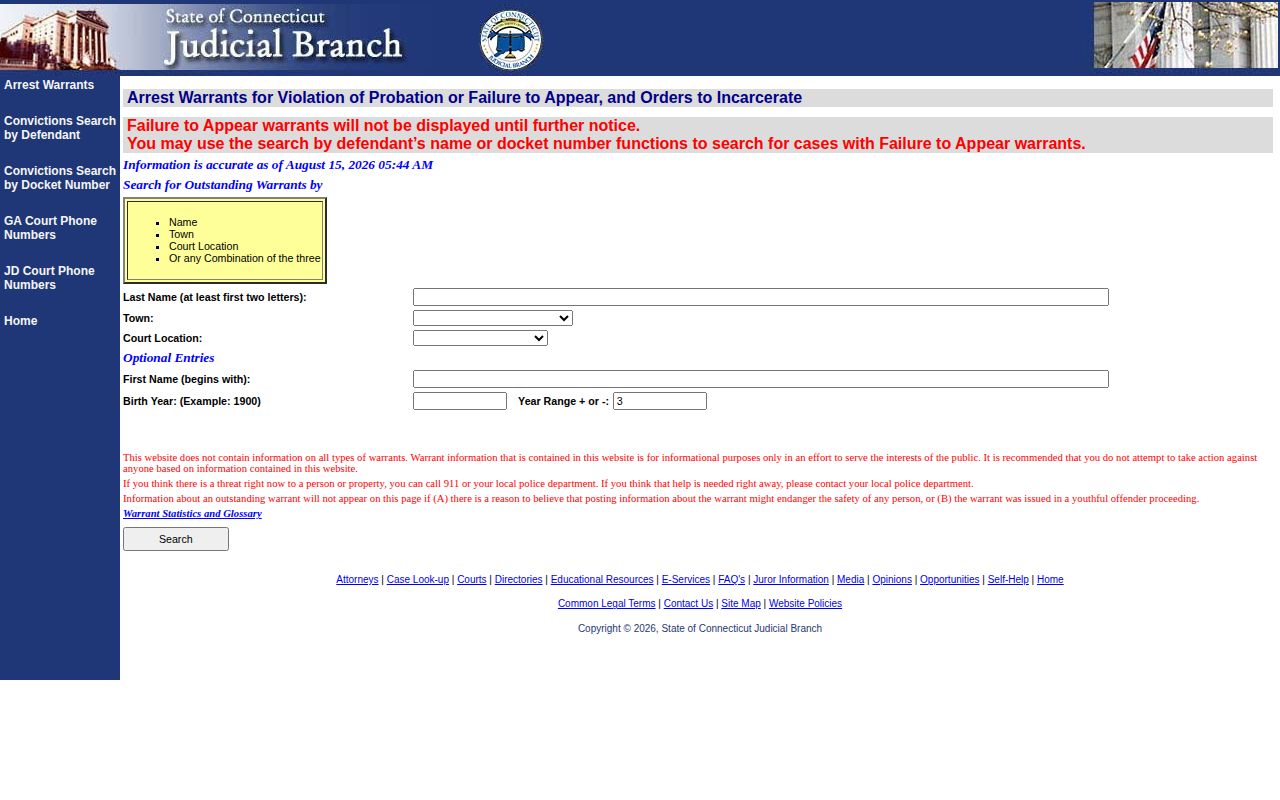
Treat the interface as a first check only. Match any result with care. A blank result never proves that no warrant exists.
- Start at the Judicial search and enter the identifying information the form requests. Use exact details rather than a nickname.
- Compare the result with reliable identifying facts. A common name alone is not enough to link a warrant to a person.
- Read the tool's limitation notice. It does not promise full coverage of every active warrant category.
- When the issue concerns Hartford court, contact the Geographical Area 14 clerk or a lawyer to confirm the next lawful step.
- Arrange any appearance, surrender, or court response through counsel or the relevant court. Do not rely on tips designed to delay or avoid service.
Hartford County Warrant Types
The available sources support three distinct public channels, not a broad catalog of legal warrant labels. Keeping them apart prevents a common mistake. That mistake is lumping a police notice, a Judicial database result, and a DOC parole notice together as one population. Each has its own issuer. Each has its own confirmation route.
| Public channel | What it covers | Main limit |
|---|---|---|
| Judicial active warrant / VOP search | Active arrest-warrant and violation-of-probation records included by the Connecticut Judicial Branch | Judicial says some active warrant types may not appear |
| Curated individual notice | A specific, dated HPD or other agency fugitive or suspect notice | Not a complete Hartford County list; status may change after publication |
| CT DOC parole fugitive notice | People accused of absconding from parole or community supervision within the unit's scope | Not a general city warrant channel and not an HPD most-wanted list |
A violation of probation, or VOP, means someone allegedly broke a rule of court-ordered probation. Parole is different. It's supervision after release from correctional custody. People mix the two up constantly. They come from separate systems, with separate agencies behind them.
Hartford County Tip Channels
Hartford Police takes anonymous tips on the line listed on its official department page. The CT DOC Parole Fugitive Investigations Unit has its own number. That one is for parole absconders and related supervision cases. Call the right channel. The DOC line isn't a substitute for ordinary HPD reports. And neither number should ever be used to pressure or confront anyone.
Hartford Police Anonymous Tips
Phone: (860) 722-TIPS (8477)
Online: Tip form linked from the Hartford Police Department page
Emergency: 911
Scope: Hartford police information and time-sensitive public-safety tips
CT DOC Parole Fugitive Tips
Agency: Parole Fugitive Investigations Unit
Phone: (203) 346-7830
Scope: Parole absconders or people alleged to have escaped community supervision, not general Hartford warrants
Hartford police do not run a standing most-wanted reward program that can be confirmed. A tip line taking calls does not mean cash is on the table. Some wanted notices spell out their own terms. When one does, that notice governs. Keep a copy of it. Note the date printed on it. Then work only with the agency named inside.
Note: Report what you actually saw, not what you suspect. A car's make, a street name, or the time you saw someone often beats a theory shared online.
Resolve Hartford Warrants Safely
Worried a Hartford arrest warrant has your name on it? A web search will not settle the question. Go straight to the courthouse instead. Most Hartford criminal cases move through Geographical Area 14 at Hartford Superior Court, sitting at 101 Lafayette Street, Hartford, CT 06106. Call the Chief Clerk at (860) 566-1630. The directory lists doors opening at 8:30 a.m., with counter business running 9:00 a.m. to 5:00 p.m.
A lawyer should come first whenever the situation is unclear or a court date is likely. Counsel can call the right clerk, pin down the correct case, and set up a lawful response, whether that means an arranged appearance or a planned surrender. The clerk's office can explain procedure and tell you which courthouse holds the file, though it cannot serve as your legal adviser. What never works is hiding, destroying evidence, lying to police, or hoping an online entry vanishes on its own.
One more distinction matters. A warrant is a judge's authorization tied to an open matter, while a disposition is the court's final outcome, such as dismissal or conviction. Warrant pages never show that ending. When you need formal proof of how a case closed, follow the docket and request a certified disposition from the clerk of the court that heard it.
Hartford Wanted Status and Innocence
Names repeat, and typos creep into databases. A wanted listing, arrest entry, or fugitive notice reflects an unresolved legal status rather than a settled fact about a person. Match more than one solid detail before drawing any conclusion. The originating court or agency holds the freshest status.
Custody adds another wrinkle. Someone picked up by HPD might be cited and released without ever entering CT DOC, while a person remanded by a judge can show up in the statewide DOC locator. A parole fugitive sits in a separate, narrower supervision channel. Each system answers a different question, so treat none of them as a permanent label.